The Discovery of a New Class of Compounds
Our scientists have found that the body can heal itself completely when we properly regulate inflammation.
The body has the potential to achieve full regeneration, if excess inflammation does not get in the way.
The revolution is the treatment target: it is not the bacteria; it is the inflammation
Although the inflammatory response is protective, unresolved, continuous inflammation is detrimental to tissue function, promoting microbiome dysbiosis.
Failure to resolve inflammation leads to chronic diseases, including type 2 diabetes, cardiovascular diseases (CVDs), Alzheimer’s Disease, rheumatoid and inflammatory arthritis and periodontal diseases.
Research
What is Inflammation?
Inflammation is the body’s first-line defense after injury or infection.
For more than 2000 years we thought that inflammation resolved when the stimulus went away.
Currently, we use anti-inflammatory drugs to inhibit inflammation. But most of these drugs depress resistance to infection and have multiple side effects, delay the resolution of inflammation and prolong the infection.
Inflammation brings healing mechanisms to the site of the problem.
Inhibiting these chemical mediators to reduce the signs of inflammation does not solve the problem!
Previous Thinking
The five signs of inflammation have been known for more than 2000 years. Roman physician Aulus Cornelius Celsus described them as:
- Calor (heat)
- Rubor (redness)
- Tumor (swelling)
- Dolor (pain)
- Functio laesa (loss of function)

Rudolph Virchow
We are using drugs to stop acute inflammation,
but these drugs also block the body from being fully engaged in resolving inflammation and result in multiple side effects.
Discovery
Resolving & Regenerating
The body has the potential to achieve full regeneration, if excess inflammation does not get in the way.
NOCENDRA’S leading scientists are at the forefront of this discovery and are developing new drugs to enhance the body’s natural healing capabilities by limiting excess inflammation.
New research shows that the body has the capability to produce molecules that resolve inflammation naturally while enhancing the immune system. They have dual actions controlling inflammation and promoting healing with no known side-effects.
Our scientists have realized that the body can heal itself completely, without scarring, if we can properly regulate inflammation.
Natural Control Mechanisms: Specialized Pro-resolving lipid Mediators (SPMs)
The body has natural dual actions mediators.
SPMs both initiate and regulate inflammation, therefore, SPMs are both anti-inflammatory and pro-resolving.
The role of SPMs in inflammation
Reverse the five cardinal signs of inflammation
Induce secretion of healing molecules
Remove dead cells
Clean-up debris
Stimulate the release of other SPMs changing the inflammatory status of the whole body
SPMs are agonists; they bind to a cell to change the cell’s activity from pro-inflammatory to pro-resolution.

Pre-Clinical Studies
Rabbit Periodontitis
Pre-clinical studies were done in rabbits; periodontitis was induced with a human pathogen.
Measures were made of tissue changes – pocket depth and bone changes – infrabony pockets.
The 12-weeks experiment was able to demonstrate that our product showed:
No toxicity
Abatement of the disease
Regeneration of the tissues
Conclusions from Pre-clinical Studies
The Role of SPMs in Periodontal Regeneration:
SPMs reverse periodontal inflammation
SPMs arrest progressive periodontitis
Elimination of inflammation promotes spontaneous regeneration of lost tissues
Outcomes
Reduction in Soft Tissue-Pocket Depth Measurements

Hard Tissue-Infrabony Pocket Depth Measurements
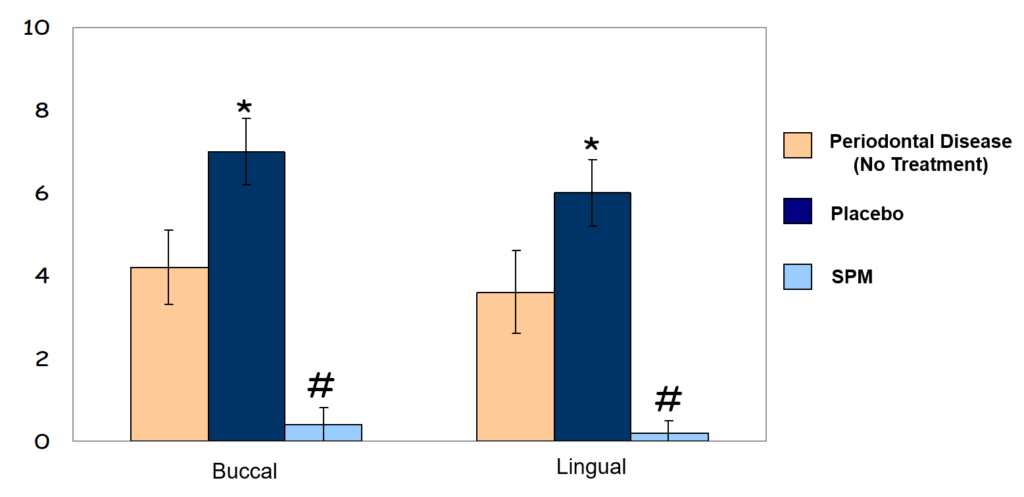
* p <0.05 compared to “Periodontal Disease Group”
* p <0.01 compared to both “Periodontal Disease Group” and “Placebo”
Clinical Trials
Since 2024, several active Clinical Trials have been performed and are continuing in Finland, Norway, Turkey, the UK and Lithuania.
Development of a daily mouthwash that is safe and effective. Approved as Class 1 device in EU (fulfilling the MDCG`s MDR 2017/745 regulations.
Positive clinical study results:
In a Phase 1 trial in the US, gingivitis was evaluated after 28 days use of the mild form of the mouthwash. Patient groups included:
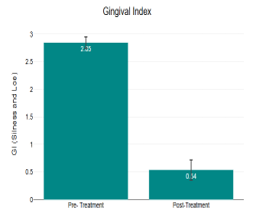
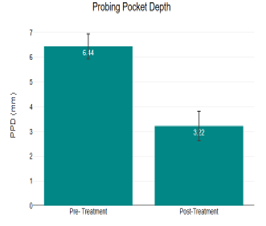
Results revealed significant reductions in gingivitis as well as probing pocket depths in patients with periodontitis (Figures 1 and 2, respectively).
127 enrolled subjects
50 active ingredient (0.33 µg/ml Mild Formulation)
50 placebo
27 no rinse
Change in Probing Depth
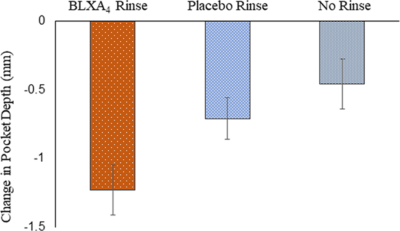
Figure 2
*Frontiers: https://doi.org/10.3389/fimmu.2021.704163
Change in Gingival Index (Mean + SEM)
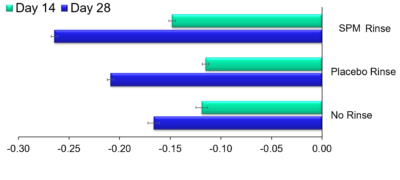
Figure 1
*Significant difference compared to placebo rinse
+Significant difference compared to placebo rinse and no-rinse
^Significant difference compared to no-rinse
Excellent Results
No toxicity
Secondary efficacy outcomes:
-
reduces gingivitis
-
reduces pocket depth
-
Further, this study confirmed that the platform is safe; efficacy demonstrated in a randomized clinical trial; prevents and treats periodontitis and peri-implantitis.
Dose ranging study
- In a dose ranging study of SPM mouthwash in a Finnish population, all doses performed better than placebo in the reduction of gingivitis (percent sites bleeding on probing).
- The test subjects (16 M and 20 F), age range 23-77 years, divided into five groups (placebo, 1, 5, 10 and 20 µg/ml)
- At doses of 1, 5 and 10 µg/ml, the improvement was statistically significant with 5 µg/ml being the optimal concentration.
- At baseline, gingival bleeding/gingivitis was recorded as percentage bleeding sites after gentle probing. Subjects were randomized to each group and were instructed to rinse daily for at least 60 seconds with the assigned mouthwash for 3 months in the evenings after brushing their teeth.
- No other treatment was performed other that oral hygiene instructions. At the end of the trial, all subjects received a complete Scaling and Root Planing.
- At baseline, gingival bleeding/gingivitis was recorded as percentage bleeding sites after gentle probing. Subjects were randomized to each group and were instructed to rinse daily for at least 60 seconds with the assigned mouthwash for 3 months in the evenings after brushing their teeth.
- No other treatment was performed other that oral hygiene instructions. At the end of the trial, all subjects received a complete Scaling and Root Planing.

Use in clinical practice
Data collected from clinical practices substantiated the utility of the product in patient management. Figure 3 provides a summary of gingivitis and pocket depth reductions provided by practitioners in patients with severe gingivitis and moderate to severe periodontitis.